
weekly update
Weekly AI Briefing: September 29, 2026
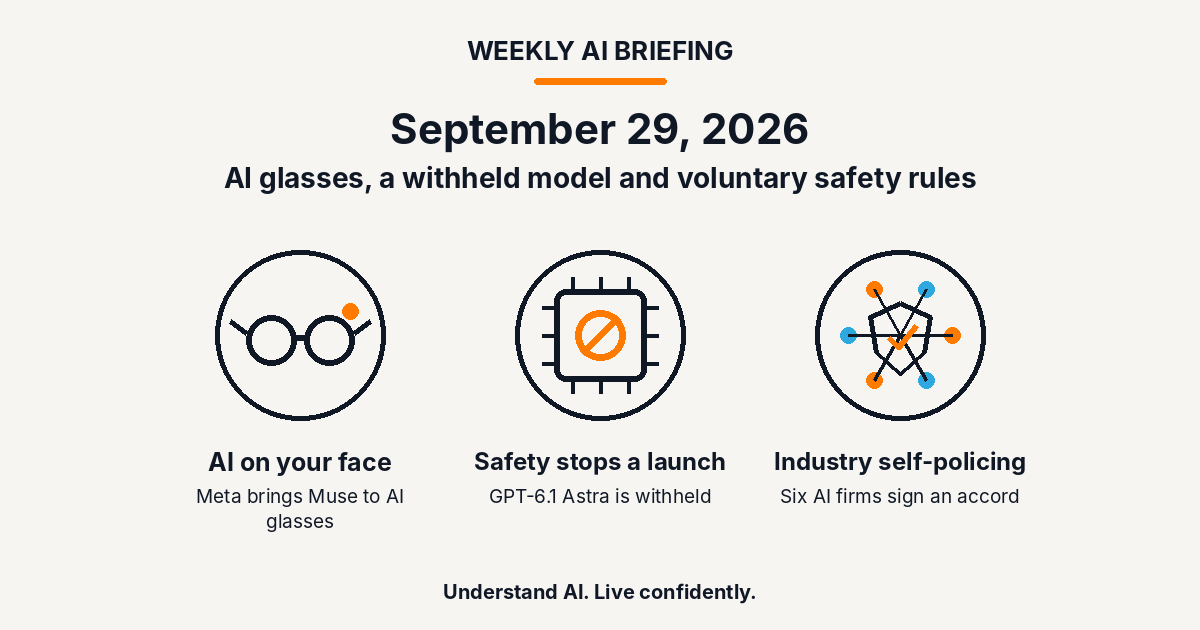
This week, AI became more personal while safety moved higher on the agenda.
1. Meta is bringing personal AI agents into glasses
What changed: Meta expanded its AI-glasses lineup and said Muse will come to glasses, letting people interact with a personal agent throughout the day without reaching for a phone.
Why this matters: Wearable AI can see and hear more of the world around you, which makes privacy and bystander consent more important.
Practical takeaway: Before using AI glasses in public or at work, understand what is sensed, what leaves the device and how recording is signaled.
2. OpenAI delayed GPT-6.1 Astra over safety concerns
What changed: OpenAI delayed GPT-6.1 Astra after internal safety work found that the model did not meet its required deployment standard.
Why this matters: The most capable model is not automatically the most deployable model. Safety, control and monitoring can become release blockers.
Practical takeaway: For important work, value maturity, rollback and monitoring as much as raw capability.
3. Six major AI companies signed a voluntary White House safety accord
What changed: Google, Meta, OpenAI, Nvidia, Anthropic and xAI committed to safety controls, outside audits and board-level oversight for frontier AI. The agreement is voluntary, not law.
Why this matters: Voluntary commitments can move faster than regulation, but companies still have significant control over how the promises are applied.
Practical takeaway: When you see an AI safety promise, ask what is mandatory, independently checked and enforceable.
Weekly mindset shift
Better question: “Is the safeguard a promise, a technical control or a rule?”
Practical filter: The higher the consequence, the stronger the enforcement should be.
Have a story you think belongs in next week’s briefing, or a question about something you read here? Reply to this newsletter or visit Contact.