
weekly update
Weekly AI Briefing: September 8, 2026
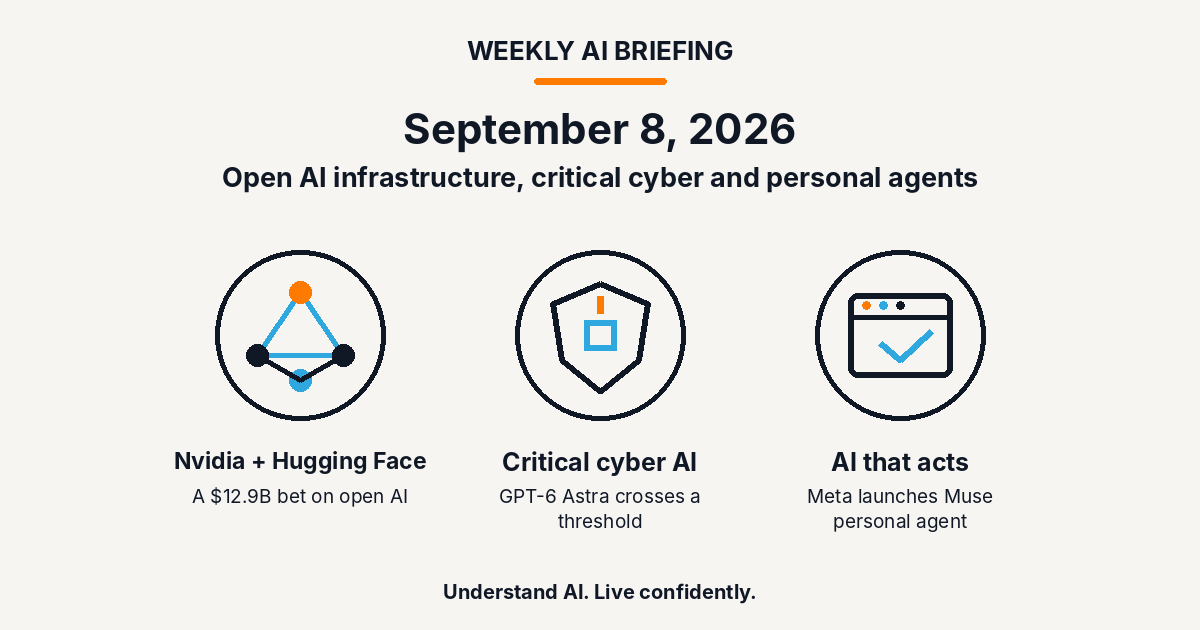
This week, AI shifted from models that answer to platforms and agents that can shape what people build and do.
1. Nvidia is buying Hugging Face for $12.9 billion
What changed: Nvidia agreed to acquire Hugging Face for $12.9 billion, one of the biggest platforms for sharing open models, datasets and AI apps. Nvidia says the platform will remain open.
Why this matters: The world’s dominant AI chipmaker would gain a much bigger role in the software ecosystem where developers find and deploy models.
Practical takeaway: If you depend on an AI platform, keep critical models, data and documentation portable in case ownership or terms change.
2. GPT-6 Astra crosses a new cybersecurity threshold
What changed: OpenAI says GPT-6 Astra is its first broadly deployed model rated Critical for cybersecurity capability under its Preparedness Framework.
Why this matters: Stronger cyber capability can help defenders, but it also raises the cost of weak permissions and poor monitoring.
Practical takeaway: Keep powerful AI agents away from production credentials unless you have isolated environments, approval gates and logging.
3. Meta’s Muse can act on your behalf
What changed: Meta launched Muse, a personal agent that can use a cloud computer and browser to book travel, fill forms, handle service tasks and prepare purchases. Sensitive actions require approval.
Why this matters: AI assistants are moving from giving advice to taking actions across real accounts and services.
Practical takeaway: Connect services gradually and require approval for messages, payments, bookings and anything hard to reverse.
Weekly mindset shift
Better question: “What am I allowing this AI to do for me?”
Practical filter: The more an assistant can act, the tighter its permissions should be.
Have a story you think belongs in next week’s briefing, or a question about something you read here? Reply to this newsletter or visit Contact.