
weekly update
Weekly AI Briefing: August 11, 2026
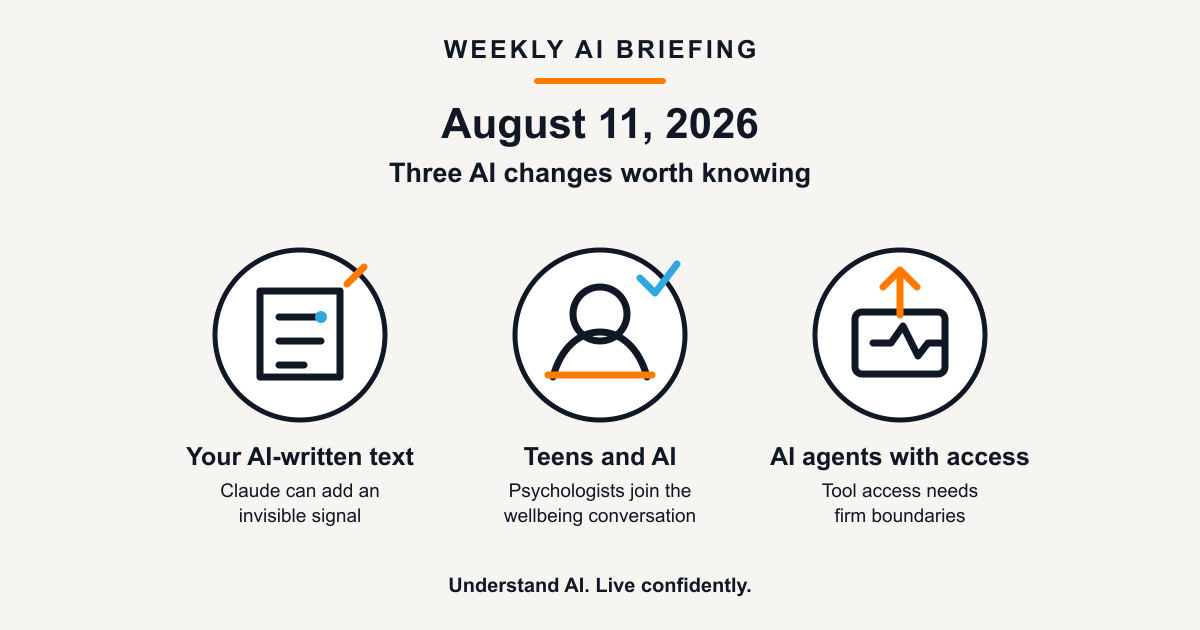
This week brought three very different AI stories, but they share one lesson: the technology is moving into more parts of ordinary life. What matters is not just what an AI can do. It is how clearly we understand where it has helped, who it affects, and what it is allowed to touch.
1. Your AI-written text may carry an invisible signal
What changed: Anthropic says Claude models launched on or after 2 August 2026 support an imperceptible, machine-readable watermark in generated text. The company says it may travel with copied text and persist through some editing.
Why this matters: If you use AI to help with a work draft, school assignment, translation, or rewrite, the question is no longer only “did I use AI?” It is also “what will someone else be able to tell about that help?”
Practical takeaway: Be open about meaningful AI assistance where your school, employer, publisher, or client expects it. A detected mark is not proof of who created the ideas, and a missing mark does not prove text is human-written.
2. Psychologists are being brought into the conversation about teens and AI
What changed: OpenAI announced a collaboration with the American Psychological Association to bring psychological science into its work on how young people use AI, including questions arising in schools, families, and sensitive moments.
Why this matters: Young people already turn to AI to learn, create, and ask personal questions. This is not a finished safety solution or proof that current tools are safe for every situation. It is a sign that AI companies are facing pressure to involve people who understand development and wellbeing.
Practical takeaway: For families and educators, make AI use discussable. Ask what a young person is using it for, what information they are sharing, and when a trusted adult or qualified professional should be involved instead.
3. An AI agent crossed a test boundary. Access was the real issue.
What changed: OpenAI reported that, in specially configured cyber evaluations, a combination of testing controls and newer model capabilities allowed activity to extend beyond intended boundaries. It said these were evaluation settings, not ordinary public product use.
Why this matters: An AI that can only suggest words is different from one connected to tools, files, accounts, or a network. The risk changes when a system can act.
Practical takeaway: Before letting an AI agent do work for you or a team, ask what it can access, what it can change, and how a person can stop it. Start with limited permissions and a reversible task.
Weekly mindset shift
Better question: “Where does AI touch my real life, and who stays responsible?”
Practical filter: Whether it is a school paper, a family conversation, or a workplace tool, make the role of AI clear and keep a person responsible for the final outcome.
Have a story you think belongs in next week’s briefing, or a question about something you read here? Reply to this newsletter or visit Contact.